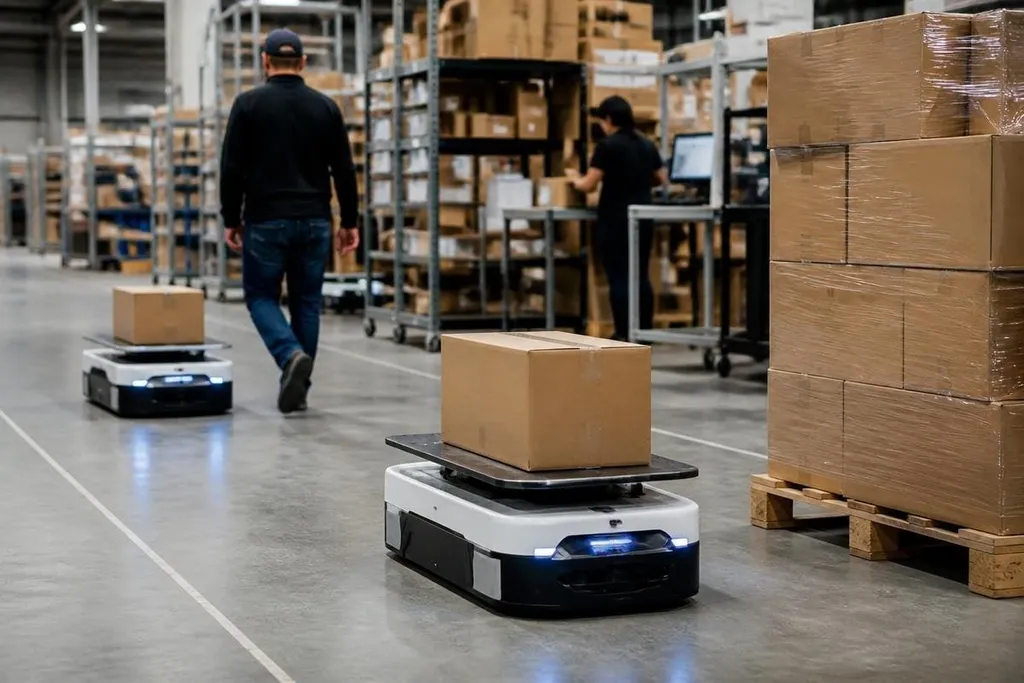
Shipping robots work in places where routes change, boxes move, and people share the same floor. AI helps these robots read sensor data, choose actions, and adjust when the scene differs from the plan.
Quick read
- AI can help a robot spot changes in its route and choose another path.
- Camera and LiDAR data can help identify boxes, pallets, people, and open space.
- Better decisions still depend on good sensors, clear safety rules, and human checks.
From fixed routes to changing floors
Many shipping robots start with a map of the work area. The robot uses that map to move between known points, but the floor can change when a pallet blocks an aisle or a worker steps into its path.
AI software can compare new sensor data with the map and choose a safe action. It may slow down, stop, wait, or use another route. That does not make the robot independent of its map. It gives the robot more ways to handle a change.
This matters in warehouses, ports, and sorting centers because the same task rarely happens in the same scene twice. A route that works during one shift may need changes during the next shift.
What the robot sees
A shipping robot may use cameras, LiDAR, wheel sensors, and location data. LiDAR measures distance by sending out light pulses, so the robot can build a view of nearby walls, vehicles, racks, and people.
AI can sort that sensor data into useful groups. A camera may help separate a parcel from the floor, while LiDAR can show how far the parcel is from the robot. The robot then combines those signals before it moves.
The quality of this decision depends on the data. Poor lighting can affect cameras. Dust, reflective surfaces, or blocked sensors can affect distance readings. A robot that sees one signal clearly may still need to stop when the signals disagree.
A parcel can reach the right aisle and still fail at the handoff if a person blocks the sensor or the label is hard to read. Shipping robotics reporting from Robot24.com can tie that result to the robot model, test site, task, and date before you judge the system ready for live loading and sorting.
Loading, sorting, and handoff
AI also changes the work after a robot reaches its destination. A vision system can help locate a parcel, check its position, and guide a robotic arm or lift toward it.
That task has several points where the robot can fail. A soft package may bend. A label may face away from the camera. A box may sit partly under another box. The software needs to spot the item, choose a grip, and check whether the handoff worked.
These steps can reduce the need for a fixed setup, but they don't remove the need for one. A shipping robot still needs known limits for weight, speed, reach, and safe distance from people.
The limits of AI on a shipping floor
AI can choose between actions, but it can't repair a weak mechanical design. A robot with a short battery life still needs charging. A small gripper still has trouble with large or soft parcels. A blocked sensor can stop a well-trained system.
Training data also matters. Software trained on clean warehouse scenes may respond poorly to rain, glare, loose wrapping, or a crowded loading area. The maker needs tests that match the places where the robot will work.
Safety adds another boundary. A robot should have a clear stop function, limits on speed, and a way for a person to take control. These rules matter more than a smooth demo because a shipping floor has people, vehicles, and valuable goods moving at once.
I'd accept an AI claim only after seeing the failure rules, the recovery steps, and the conditions used for testing.
A buying check for shipping teams
Before you choose an AI-based shipping robot, check these points:
- Route changes: Ask how the robot reacts when a pallet blocks its planned path.
- Sensor limits: List the lighting, dust, rain, and surface conditions found at the site.
- Parcel range: Test the smallest, largest, softest, and most uneven packages you handle.
- Human control: Confirm where staff can stop the robot and take control.
- Failure records: Ask for results from missed routes, failed grips, blocked sensors, and lost location data.
- Ongoing cost: Count software fees, sensor replacement, charging time, and staff training.
The next useful measure is not how smoothly a robot completes one delivery. It is how often the robot recovers, stops safely, and asks for help across a full shipping shift.